Automated Test Equipment (ATE): Enabling Efficient and Scalable Manufacturing

In an era where manufacturing speed and product reliability define success, businesses must adopt smarter ways to validate their products. Increasing complexity, tighter deadlines, and the need for consistent quality have made traditional testing methods less effective. To overcome these challenges, industries are turning to Automated Test Equipment (ATE) as a core part of their production strategy.
ATE helps organizations standardize testing, improve accuracy, and significantly enhance overall manufacturing efficiency.
As global competition intensifies, manufacturers are under constant pressure to deliver high-quality products faster while maintaining cost efficiency. This is where ATE plays a crucial role by enabling intelligent testing processes that align with modern production demands.
What is Automated Test Equipment (ATE)?
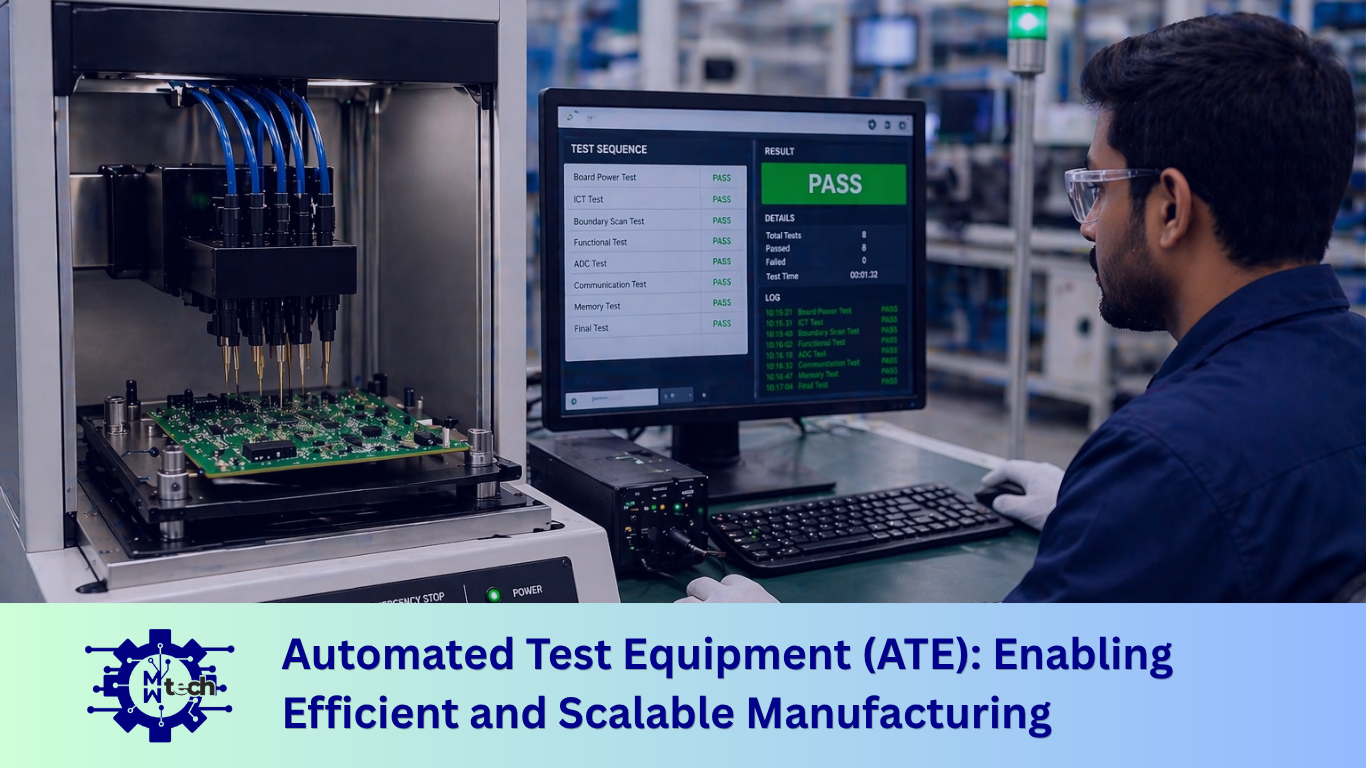
Automated Test Equipment (ATE) is an integrated system of hardware and software used to automatically evaluate products for performance, functionality, and quality. By reducing dependence on manual processes, it ensures faster execution, reliable measurements, and consistent outcomes across large production volumes.
In addition, ATE systems can be customized to meet specific testing requirements, making them suitable for a wide range of industries including electronics, automotive, aerospace, and industrial manufacturing.
The Growing Need for ATE in Manufacturing
Manual inspection and testing often lead to inconsistencies, slower throughput, and higher operational costs. ATE addresses these gaps by introducing automation and intelligence into the testing process.
Key advantages include:
• Faster Throughput: Supports continuous, high-speed production environments
• Precision Testing: Delivers highly accurate and repeatable results
• Operational Efficiency: Minimizes manual effort and human-related errors
• Cost Optimization: Reduces testing time and overall production costs
• Flexible Integration: Can be adapted to different products and industries
Core Elements of an ATE System
Additionally, ATE enables manufacturers to scale operations without significantly increasing manpower, making it ideal for growing production demands.
A well-designed ATE solution is built on several essential components:
• Mechanical Interfaces: Fixtures and connectors that link the product to the test system
• Measurement Instruments: Equipment used to capture electrical, signal, or performance data
• Control Units: Systems such as industrial computers or controllers that execute test sequences
• Automation Software: Platforms for programming tests, collecting data, and generating reports
• Safety Mechanisms: Systems that ensure secure operation and protect both equipment and operators
Modern ATE systems also include data analytics capabilities, allowing businesses to monitor performance trends and identify potential issues before they escalate.
Where ATE is Used
Automated Test Equipment (ATE) is widely used across multiple industries wherever product testing, validation, and quality assurance are required. Its flexibility allows it to support different types of products, processes, and production environments.
Product Functionality Testing
Ensures that products operate as intended under defined conditions.
Component & Assembly Validation
Verifies the integrity and performance of individual components and assembled units.
Performance & Compliance Testing
Evaluates whether products meet required standards, specifications, and regulations.
Environmental & Stress Testing
Assesses product reliability under varying environmental and operating conditions.
Quality Assurance & Inspection
Supports consistent quality checks throughout the production lifecycle.
Final Product Verification
Confirms that finished products are ready for deployment or shipment with complete functionality and reliability.
This broad applicability makes ATE a critical solution for any industry focused on delivering consistent, high-quality products at scale.
Business Benefits of ATE Implementation
Adopting ATE solutions brings measurable improvements to manufacturing operations:
• Increased production consistency
• Enhanced product reliability
• Lower rejection and rework rates
• Faster time-to-market
• Better traceability with detailed test data
Moreover, real-time data generated by ATE systems allows businesses to make informed decisions, optimize processes, and continuously improve product quality.
ATE and the Future of Manufacturing
As industries continue to evolve toward automation and smart manufacturing, ATE is becoming a foundational technology. It not only improves testing efficiency but also supports scalability by enabling manufacturers to handle higher volumes without compromising quality.
With the rise of Industry 4.0, ATE systems are increasingly being integrated with IoT, AI, and cloud technologies, enabling predictive maintenance, remote monitoring, and advanced analytics. This transformation is helping manufacturers move toward more connected, intelligent, and data-driven production environments.
Modern ATE systems can be tailored to specific production needs and integrated with existing workflows, making them a valuable long-term investment.