How LabVIEW Helps in Test, Measurement & Control

Introduction
In today’s competitive industrial environment, speed, accuracy, and reliability are essential for delivering high-quality products. Whether you’re developing new products, validating performance, or automating production testing, having the right software platform is critical. LabVIEW, developed by National Instruments (NI), has become one of the world’s leading platforms for test, measurement, and control (TMC) applications.
Its graphical programming environment, extensive hardware support, and rapid development capabilities enable engineers to build intelligent systems that improve productivity, reduce costs, and enhance product quality.
What Makes LabVIEW Ideal for Test, Measurement & Control?
LabVIEW combines data acquisition, instrument control, analysis, visualization, and reporting into a single development platform. Instead of writing thousands of lines of code, engineers can develop powerful applications using an intuitive graphical programming approach.
This significantly reduces development time while providing exceptional flexibility for industrial and laboratory applications.
1. Automated Testing
Manual testing is often slow, repetitive, and prone to human error. LabVIEW automates the entire testing process, ensuring every product is tested consistently and accurately.
Benefits:
- Faster production testing
- Improved repeatability
- Reduced operator intervention
- Automated pass/fail decisions
- Automatic report generation
Typical Applications
- End-of-Line (EOL) Testing
- Functional Testing
- Burn-In Testing
- Reliability Testing
- Validation Systems
2. High-Speed Data Acquisition
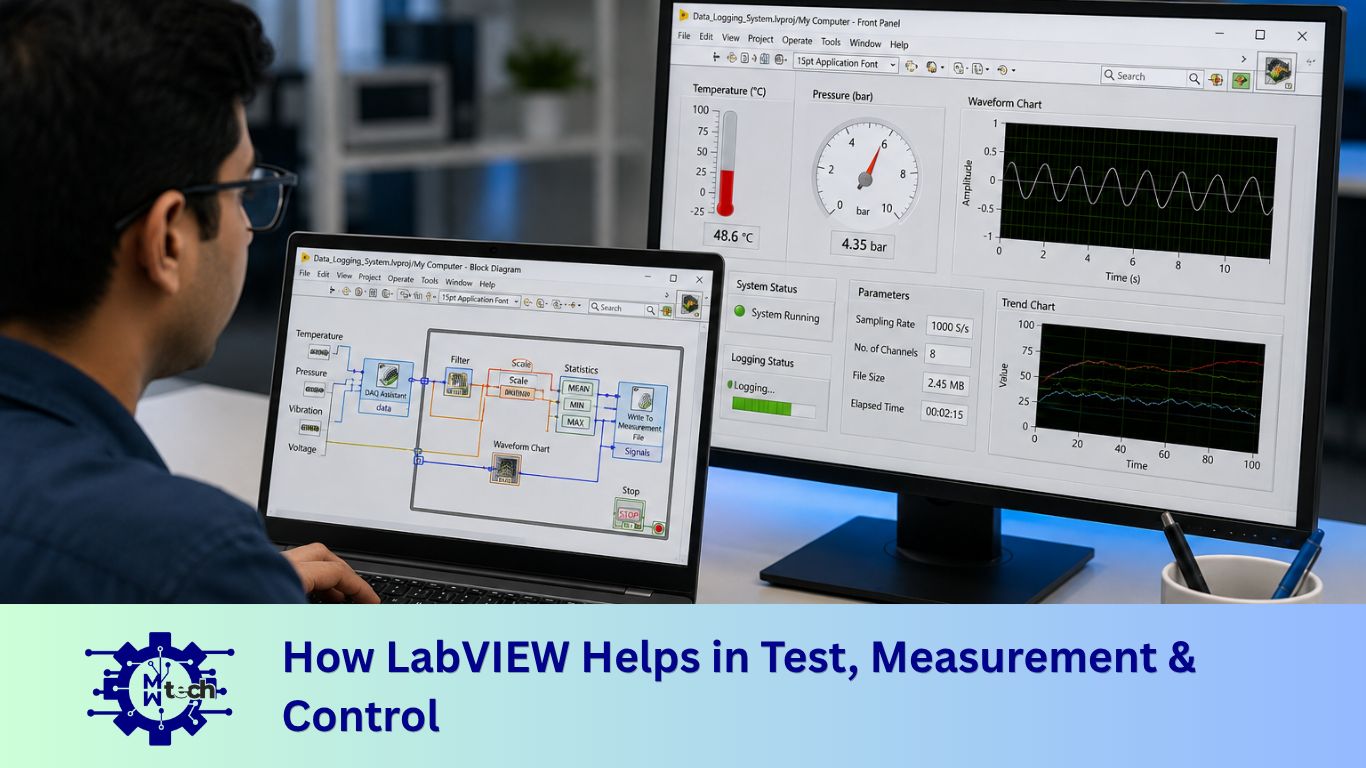
Modern industries require precise measurement of electrical, mechanical, thermal, and process parameters. LabVIEW works seamlessly with NI DAQ hardware and third-party devices to acquire real-time data at both low and high sampling rates.
Benefits:
- Multi-channel data acquisition
- High-speed sampling
- Real-time visualization
- Signal synchronization
- Accurate data recording
Typical Measurements
- Voltage
- Current
- Temperature
- Pressure
- Force
- Torque
- Vibration
- RPM
- Flow
- Displacement
3. Instrument Control
LabVIEW communicates with a wide range of laboratory and industrial instruments, allowing complete automation of test setups from a single software platform.
Supported interfaces include:
- USB
- Ethernet
- GPIB
- Serial (RS232/RS485)
- Modbus TCP/IP
- CAN Bus
- OPC UA
This enables centralized control of oscilloscopes, power supplies, electronic loads, multimeters, signal generators, and many other instruments.
4. Industrial Process Control
LabVIEW is widely used for controlling industrial machines and processes. It integrates easily with PLCs, sensors, actuators, drives, and control systems to create intelligent automation solutions.
Common Applications
- Machine automation
- Process monitoring
- Motion control
- Temperature control
- Pressure regulation
- Motor testing
- Vision inspection
- Production line monitoring
5. Real-Time Monitoring & Visualization
One of LabVIEW’s greatest strengths is its ability to display live data through interactive dashboards and graphical interfaces.
Engineers can monitor:
- Live trends
- Waveforms
- Gauges
- Digital indicators
- Alarm status
- Production statistics
- System health
Real-time visualization enables quicker decision-making and faster troubleshooting.
6. Advanced Data Analysis
Collecting data is only the first step. LabVIEW includes powerful built-in analysis tools that transform raw data into meaningful insights.
Capabilities include:
- FFT Analysis
- Signal Filtering
- Statistical Analysis
- Frequency Analysis
- RMS Calculations
- Peak Detection
- Vibration Analysis
- Mathematical Functions
These features help engineers identify faults, optimize processes, and improve product performance.
7. Automated Reporting & Data Logging
LabVIEW automatically stores test results and generates professional reports without manual effort.
Reports can be exported to:
- Excel
- CSV
- SQL Databases
Automated reporting improves traceability, quality documentation, and compliance with industry standards.
Industries Using LabVIEW
LabVIEW is trusted by organizations across multiple industries, including:
- Automotive
- Aerospace
- Electronics Manufacturing
- Medical Devices
- Industrial Automation
- Power & Energy
- Research & Development
- Semiconductor
- Educational Institutions
Why Choose MeasureMint Technologies?
At MeasureMint Technologies, we specialize in designing and developing custom LabVIEW applications for industrial automation, test systems, and data acquisition. Our experienced engineers build scalable, user-friendly, and high-performance solutions that integrate seamlessly with NI hardware, PLCs, sensors, and third-party instruments.
From requirement analysis and software development to commissioning and long-term support, we provide complete LabVIEW engineering services tailored to your business needs.